The Tarot! Renaissance Symbols, Modern Visions exhibit is showing in New York City’s Morgan Library until October 4th, 2026. If you love tarot cards, it is worth every effort to get there.
The show presents a narrative of tarot history from Renaissance Italy to our present day. It marks key moments with originals and very early examples of tarot cards and related memorabilia. Everything you might find in a textbook is here for you to examine in real life.
Renaissance Symbols

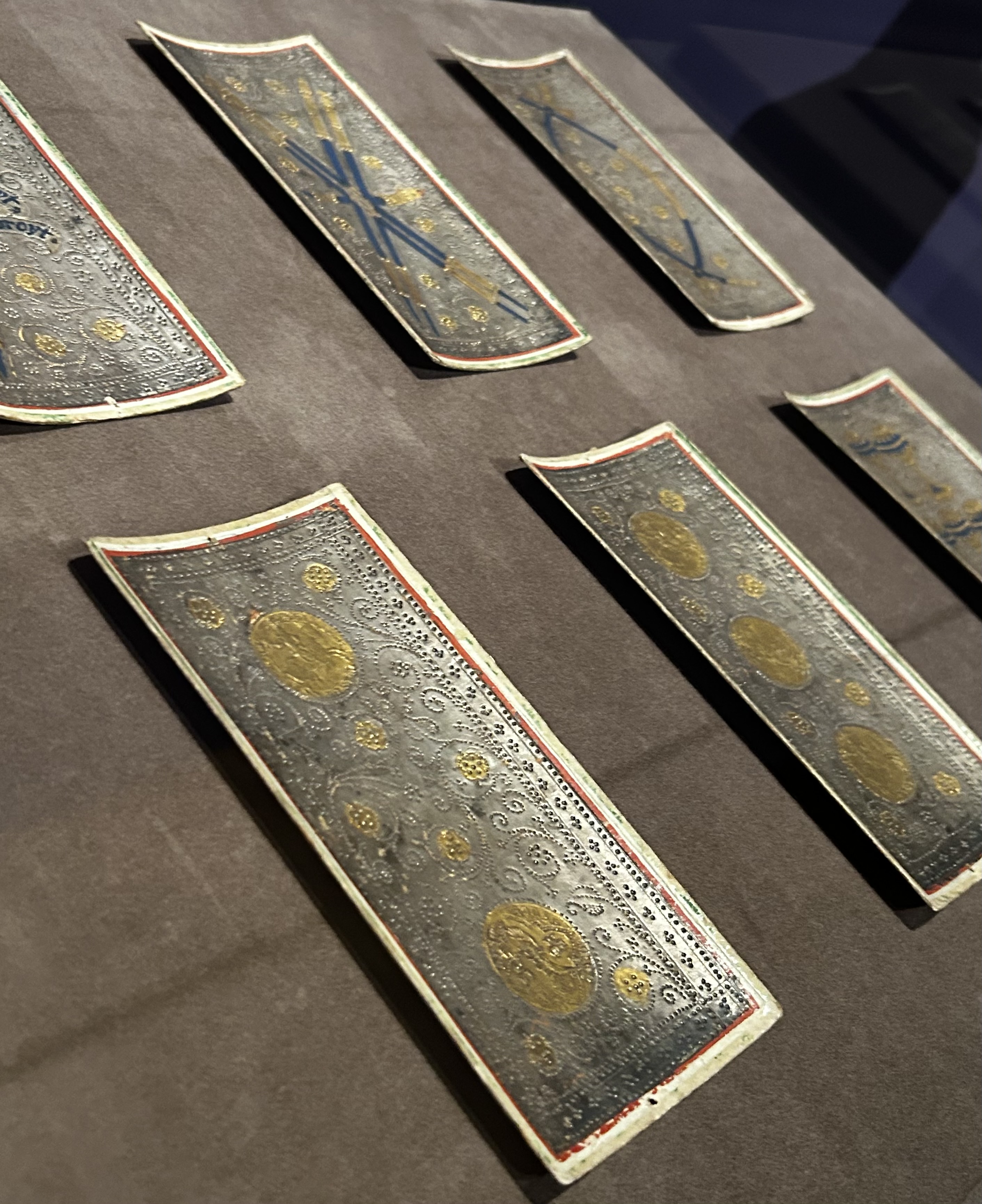
The stars of the show are cards from the Visconti-Sforza family of tarot decks. These cards date back to the mid-1400’s, when the game called Triumphi was popular among the Italian upper crust. The Visconti-Sforza cards are famous for being the oldest surviving examples of the 78-card tarot deck.
The Morgan presents the Visconti-Sforza (V-S) as the starting point of the centuries-long transition from Triumphi to the Tarot we know today. Here are some snapshots from three different V-S tarot decks in the collection.


The display of the V-S cards is lovingly curated. Go there to learn about the philosophical and cultural underpinnings of the Major Arcana images. View related artwork from prayer books, poetry, and even textiles of the day. Go around twice if there’s enough elbow room; The Morgan does not put these cards on display very often. (I last saw them in 2016.)
Renaissance Esoterica
The exhibit includes examples of palmistry, astrology, and tarot-related poetry from the 15th century, but takes pains to downplay any magical significance.

The wall plaque for this 15th century palmistry text, for instance, claims it was “likely intended more as popular entertainment than as serious tools for prognostication.”
It seems at cross-purposes to both display material, and dismiss its content, but that might be necessary to protect the prevalent view that the V-S cards were used solely for the game of Triumphi. Regardless, as a tarot reader, I enjoy seeing evidence of similar curiosities, however playful, among my 600-year-old predecessors.
The Transition From Old to New
Following the V-S cards, the exhibit documents headline moments from tarot history, including:

A view of the Rosenwald Tarot — a deck that was perhaps never realized, but was discovered as a discarded rough-draft print dated some time before 1500.
Cards from the Sola Busca Tarot Deck, also from the 15th century, but wildly different than the V-S.


Prints of the Etteilla Tarot Deck, dated 1789, which evidenced one of the first explicit connections between tarot and fortune telling.
The Big Three
The timeline accelerates to show us the three tarot decks most used today: The Tarot de Marseille, the Rider-Waite-Smith, and the Book of Thoth by Aleister Crowley. By this point in Tarot’s history, the esoteric nature of the cards is unquestioned. The exhibit includes just a few samples from each, which is enough to convey how exceptional they are.


Modern Visions
The show concludes with a roomful of modern tarot images. Unlike with the V-S cards — which are few in number and explored in depth — the chosen modern works represent a tiny sliver of what is available today. The Morgan’s curatorial choices promote today’s tarot as an edgy, sexy, museum-worthy subject — a heartwarming sentiment for those of us who are weary of the Tarot’s lowbrow reputation. Here are just a few examples of what is included in the show:


Clockwise from top: The Hermitess by Rithika Merchant, 2021; Mountain Dream Tarot by Bea Nettles, 1975; The Hanged Man by Adam Putnam, 2018, and the Xul Solar Tarot Deck 1954.
Takeaways
Despite its popularity and substance, Tarot doesn’t often get elevated to the world of fine art. I am grateful to have seen the subject presented so robustly at the Morgan.
That said, following along with the exhibit’s historical timeline feels like crossing a river on carefully-placed stepping stones, while being cautioned to not get my feet wet in the water below. The story holds together, but it’s not very deep.
Tarot has a shadow side, and that obscure undercurrent is what makes it interesting. Without its shadow, tarot would be lumped in with games like pinochle and canasta. The promise of Tarot’s shadow is what draws people to exhibits like this. It is also, I’d bet, what inspires the contemporary artists featured in the show to make tarot images of their own.
Carl Jung taught that making the shadow conscious is a form of alchemy, resulting in something that is greater than the sum of its parts. I feel that the study of Tarot history is ready for this kind of development.
It is not necessary to be an occultist oneself to be interested, nor is all of the unexamined history of an occult nature. Light is currently being cast on the Tarot de Marseille, with a compelling theory of the origin of the word “Tarot.” (That issue is raised, but never fully addressed, in the Morgan exhibit). New questions will help us get messy with the Tarot story, getting our toes wet in the river of energy that has kept the Tarot going strong centuries after the first cards were painted.
If you’ve gone to the exhibit, or if you’ve simply given thought to the history of tarot cards, please share your ideas below.

Yetta Snow is a professional tarot reader and educator based in Seattle, Washington. Her business, Present Day Tarot, approaches the Tarot as a way to bring meaning into every moment of every day.
For news about tarot classes, specials, and more from Present Day Tarot…



Leave a Reply